Resources / Blog
Helix: Coordinating agent swarms for Ada to C porting
This translation was carried out by Helix, H2LooP's code modernization platform. Helix ported an 8-package CCSDS protocol library from Ada to C in a single automated run, correcting its own output as it went - then verified the result three ways: a behavioural suite carried across from the source, an integration gate per dependency wave, and exhaustive formal proof over every public entry point.
The subject
An 8-package protocol library where a byte-order error is a mission anomaly
ccsds_ada implements the CCSDS space data-link protocols - Space Packets, AOS transfer frames, CFDP file delivery, CUC and CDS time codes, encapsulation, and SLE service taxonomy. The source language was chosen for its compile-time guarantees, and those guarantees are what a translation to C stands to lose.
| Metric | Value |
|---|---|
| Lines of Ada | 2,408 |
| Packages | 8 |
| Preconditions | 35 |
| Postconditions | 17 |
| Range types | 20 |
Why this language pairing is hard
Ada carries specification that C has no way to hold. A declaration like type APID_Type is range 0 .. 16#7FF# is enforced by the compiler at every assignment; the natural C translation is uint16_t, which accepts anything. A Pre => clause is a checked contract; in C it becomes, at best, an assert somebody remembered to write.
Seventy-two contracts and constrained types in this library have no representation in the target language. A translation can be syntactically flawless and silently discard every one. The gap is therefore in the contracts, not the syntax.
The source library
Eight Ada specification packages, each a distinct area of the CCSDS standard. Helix reads the repository as it is - its own project file, its own build, its own test programs - rather than requiring it be restructured first.
| Package | Covers | Spec lines |
|---|---|---|
| ccsds.ads | Root types: APID, sequence count, packet version, data length | 158 |
| ccsds-cfdp.ads | File Delivery Protocol: PDU headers, directive and condition codes | 245 |
| ccsds-time_codes.ads | CUC and CDS time code formats | 219 |
| ccsds-aos_frames.ads | AOS transfer frames, virtual channels, frame error control | 155 |
| ccsds-sle.ads | Space Link Extension service taxonomy | 136 |
| ccsds-space_packets.ads | Space Packet primary header and payload | 130 |
| ccsds-encap_packets.ads | Encapsulation packets and length-of-length encoding | 111 |
| ccsds-crc16.ads | CRC-16-CCITT-FALSE, single-shot and streaming | 82 |
The repository also ships four hand-written test programs - no framework, just Check_X ("name", …) calls - which Helix builds and runs against the original Ada before trusting anything downstream. A suite that cannot be made to pass on the source is not a usable oracle for the target.
The dependency graph Helix constructed
12 capability requirements · 3 levels · derived, not declared
Decomposition is not package-by-package. It decomposes the library into capabilities - what the code does, not where it lives - and derives dependency edges between them. Each requirement's level is its longest path through that graph, which is what makes independent work provably independent.
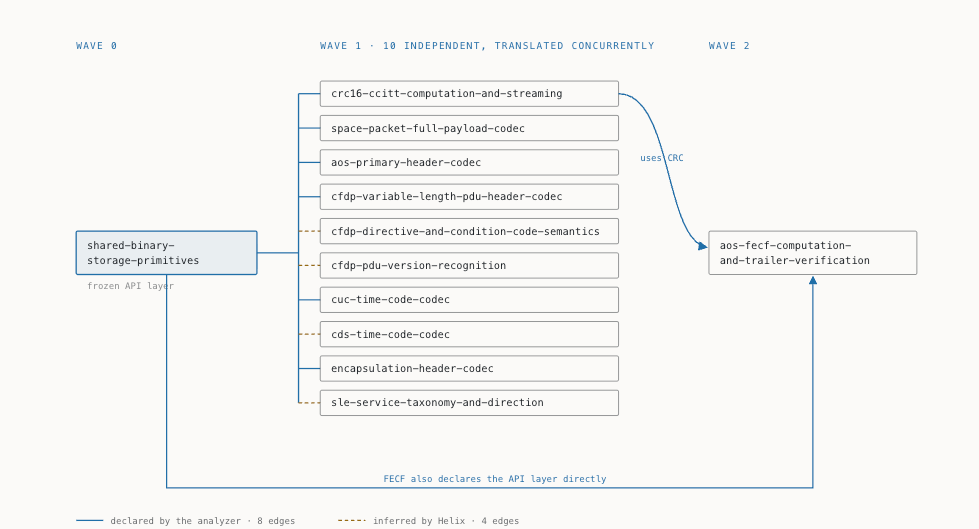 The graph Helix derived. One structural requirement forms the frozen API layer. Eight edges into it were declared by the analyzer; four were inferred by Helix, which is what puts every capability behind the shared type surface rather than beside it. The ten wave 1 capabilities depend on nothing else, so all ten translate at once; only FECF has a second dependency, so it waits.
The inferred edge
Analysis produces the edges a reader would recognise - AOS frame checking needs CRC. Helix adds one kind of its own: every requirement outside the frozen API layer depends on all of it. On this library that inferred four extra edges.
Without it, the shared type surface would be translated concurrently with the code that compiles against it, and each translator would invent its own version of the same integer aliases and structures. The edges are cycle-free by construction - they run only outward from the API layer, and an API member declares no dependencies - so the schedule can never deadlock as a result.
The consequence is intended and worth stating plainly. Nothing is independent of the API layer, so if wave 0 fails, everything fails. That is honest: nothing compiles without the shared types. A schedule that pretended otherwise would report ten green units built against a surface that never existed.
The workflow, stage by stage
Ten stages · every one an auditable queue entry
Translation is not file-to-file. It analyses the source into a requirement graph, derives a target structure from it, declares the shared API before writing any code, translates the test suite before the implementation, then admits one unit at a time.
-
Explore
-
Parse the source into a complete entity inventory - every subprogram, type and constant. This inventory is load-bearing: it becomes the mandatory checklist that later stages are measured against, so anything a parser misses is never asked about rather than flagged as missing.
-
OUTPUT8 units · 177 entity checklist items -
Requirements
-
Turn the inventory into a graph of capabilities with dependency edges - not one requirement per file, but per behaviour the library provides. Helix adds one inferred edge kind of its own: everything outside the frozen API layer depends on all of it, so the shared type surface is settled before anything compiles against it.
-
OUTPUT12 requirements · 4 inferred edges · 3 dependency waves -
Structure
-
Map every requirement to a file in an idiomatic target tree. Grouping is language-agnostic - it reads source stems, directories and requirement names - and each target language renders those placements into its own conventions. The result is
src/aos/,src/cfdp/,src/time_codes/: organised by concept, not by slug. -
OUTPUT24 files across 12 requirements -
Approve
-
The pipeline's one human gate. The proposed structure and schedule are reviewed and approved before a single line is written; afterwards nothing may recompute a target path. An unattended run stops here and says so rather than proceeding on an unreviewed plan.
-
OUTPUTstructure frozen & committed -
Scaffold
-
Commit a real, compiling skeleton to the target repository - build files, module declarations, one stub per requirement. Every unit therefore opens onto a crate that already builds, which is why the first compile inside a sandbox succeeds rather than failing on missing scaffolding.
-
OUTPUT30 files committed -
Declare the API
-
One pass, with the whole requirement graph in view, authors the shared declaration surface: type aliases, structs, function signatures with unimplemented bodies. Without it, a dozen independent translators each invent their own version of the shared types and later waves compile against whichever landed first. Gated by a real build on the target platform, and retried against the compiler's own errors until it holds.
-
OUTPUT12 requirements declared · build gate passed -
Translate the test suite - before any code
-
The source's own suite is carried across while the implementation is still stubs. A test written afterwards can be fitted to whatever the code happens to do; a test written before it cannot. Helix enforces the ordering structurally, and rejects any translated test that passes against unwritten code - a test that passes there is asserting nothing.
-
OUTPUT4 suites · 253 assertion sites · stowed until code exists -
Implement, wave by wave
-
Each requirement is translated in its own isolated sandbox: translate, build, test - three phases the sandbox reports separately, so a failure is attributed rather than inferred from an exit code. A unit is admitted only when its box built it and its tests passed, and retries refine the same workspace rather than starting over.
-
OUTPUT12/12 units translated · 171-235s each -
Merge and gate
-
Each unit merges the moment it lands rather than waiting for its wave, so conflict resolution overlaps with translations still running. Exactly one merge consumer exists, because two concurrent merges cannot share a repository. Each completed wave is then built and tested as a whole, on the target platform.
-
OUTPUT12 merges · 0 conflicts · 3/3 gates passed -
Prove, then report
-
With the library assembled, formal verification runs over every public entry point, followed by the run's final rollup. Proof runs after the last merge because merges can change code that already passed its own gate - verifying earlier would verify something that no longer exists.
-
OUTPUT1,026 properties checked across the merged library
Waves, and why concurrency is safe
A wave is a level in the dependency graph, not a batch size
Helix computes each requirement's wave as its longest-path depth over the dependency edges, so siblings stay on the same level rather than being serialised behind one another. Wave width is therefore a property of the source library, not of the machine running it.
| Wave | Requirements | Contains | Concurrency |
|---|---|---|---|
| 0 | 1 | Frozen API layer - shared binary storage primitives | 1 |
| 1 | 10 | CRC, AOS, CFDP, time codes, encapsulation, SLE, space packets | 10 |
| 2 | 1 | AOS FECF computation, which depends on CRC | 1 |
Wave 1's ten requirements are independent by construction, so all ten translated at once. Pool size is derived from the widest wave capped by the capacity of the machine actually hosting the sandboxes - never more boxes than the graph can use, never more than the host can hold.
What makes it reproducible
Every member of a wave branches from the same pinned base, fixed when the wave opens. Without that, a unit finishing early would change the starting point of one finishing later, and the same inputs would produce different histories on different machines. The wave boundary is the one hard ordering rule: every merge of wave N completes before wave N+1 dispatches.
The isolation model
One container per unit · nothing reaches the host
Each unit is translated inside its own container on a dedicated build host. The agent doing the work has no path to the orchestrator, the source repository, or any credential beyond the single API key forwarded to it by name. It edits a synced working copy and reports what it changed; the orchestrator commits outside the box.
| Property | How it is enforced |
|---|---|
| Units cannot interfere | Separate container and separate worktree per unit, even when sharing a host |
| Build output never ships | Object files, lockfiles and run state excluded from what a unit may commit |
| Gates run on the target platform | Never on the operator's machine - char signedness alone differs between them |
| Failures are attributed | Translate, build and test each report separately with their own evidence |
| Infrastructure faults are not code faults | A degraded machine is replaced, not counted against the unit's retry budget |
Provisioning is amortised across the run: containers are warmed once and reused, so the build cache stays warm and setup cost drops from tens of seconds on the first unit to under a second on the rest.
Run results
Single automated pass · 10 parallel sandboxes · launched from the console
| Metric | Result |
|---|---|
| Units translated | 12/12 — Every requirement implemented and committed |
| Merges clean | 12/12 — Zero conflicts across three waves |
| Integration gates | 3/3 — Built and tested on the target platform |
| Recorded operations | 80 — Every step auditable after the fact |
Individual units completed in 171 to 235 seconds. The whole run was launched and observed from the Helix console with no terminal in the path - the same interface a customer's engineer would use.
The translation itself
Read the C beside the Ada · every constrained type accounted for
Process evidence says a run completed. It does not say the C is any good. This section is the output read against its input: what happened to the types, what happened to the contracts, and whether the bits land where the standard says they land.
| Metric | Result |
|---|---|
| Range types preserved | 20/20 — Every Ada constrained scalar became a callable C predicate, bounds intact |
| Public functions | 61 — From 49 Ada subprograms, expanded where C needs an explicit constructor |
| Contracts as assertions | 38 — Ada Pre => clauses restated where the harness can resolve them |
| Files, concept-grouped | 24 — src/aos/, src/cfdp/, src/time_codes/ - not file-for-file |
What happened to the constrained types
This is the hardest thing to carry across, and the easiest to lose silently. Ada declares twenty constrained scalar types; C has no equivalent construct. A literal translation maps each to the nearest integer width and the constraint disappears with no diagnostic.
Every one of the twenty came across as a named type plus a callable validity predicate, with the bounds preserved exactly - including the lower bounds, which are the ones a careless port drops:
| Ada declaration | C type | C predicate |
|---|---|---|
| type APID_Type is range 0 .. 16#7FF# | apid_type_t | x <= 0x7ffu |
| type Sequence_Count_Type is range 0 .. 16#3FFF# | sequence_count_type_t | x <= 0x3fffu |
| type Virtual_Channel_ID is range 0 .. 63 | aos_virtual_channel_id_t | x <= 63 |
| type Frame_Count_Type is range 0 .. 16#FFFFFF# | aos_frame_count_type_t | x <= 0xFFFFFF |
| type Entity_ID_Length is range 1 .. 8 | cfdp_entity_id_length_t | x >= 1u && x <= 8u |
| type CUC_Coarse_Octets is range 1 .. 4 | cuc_coarse_octets_t | x >= 1u && x <= 4u |
| type Reporting_Cycle is range 0 .. 600 | sle_reporting_cycle_t | x <= SLE_REPORTING_CYCLE_MAX |
One case is worth reading closely. Data_Length_Type is range 0 .. 16#FFFF# became uint16_t with the predicate (void)x; return true;. That is not a stub - the C type's own range is exactly the Ada range, so the check is genuinely vacuous and the translation says so rather than emitting a comparison that can never fail. The predicate still exists, so call sites read identically to every other domain and a later widening of the type has one place to change.
What happened to the unconstrained arrays
Ada's Byte_Array carries its own bounds; the reflexive C translation is a bare uint8_t *, which loses them. The port instead defines a view type passed by value, so length travels with the pointer and every callee has the bound the Ada guaranteed:
/* Storage_Array is represented as a view: the pointer denotes the first
   element and length is the number of elements. Passing the view by value
   preserves Ada's unconstrained-array bounds without exposing a bare pointer. */
typedef struct {
    const ccsds_byte_t *data;
    size_t              length;
} ccsds_byte_array_t;
Side by side: CRC-16, contract and all
The source states a precondition; the translation states it too, and says where it came from. Note also what the translation chose not to copy - the Ada special-cases a two-byte buffer, the C does not need to, because a CRC over a zero-length payload already returns the initial register value:
**Ada - ****ccsds-crc16.ads/.adb**
function Verify_Trailer (Full : Byte_Array)
  return Boolean
  with Pre => Full'Length >= 2;
if Full'Length = 2 then
  Actual := Initial_Value;
else
  Actual := Compute (Full (Full'First .. Payload_Last));
end if;
**C - ****src/crc16.c**
bool crc16_verify_trailer(ccsds_byte_array_t full)
{
  /* This is the Ada Pre condition: Full'Length >= 2. */
  assert(full.length >= 2u);
const ccsds_byte_array_t payload =
  { full.data, payload_length };
return crc16_compute(payload) == expected;
The comment carries the provenance: a reviewer reading the C alone can see that the assertion is a transcribed source contract rather than a defensive guess. The CRC parameters survive verbatim - polynomial 0x1021, seed 0xFFFF, check value 0x29B1 over "123456789" - and the fold is written with an explicit cast on every shift, which is the integer-promotion trap that silently breaks hand-written CRC code in C.
Side by side: the Space Packet primary header
Six bytes with fields at bit boundaries - the place a translation is most likely to be subtly, undetectably wrong. The standard's layout, the Ada, and the C agree field by field:
Byte 0: [VVV T S AAA] CCSDS 133.0-B-1
-- Ada
Result (0) := Byte (Shift_Left (V, 5) or Shift_Left (T, 4)
                    or Shift_Left (S, 3) or A_H);
Result (2) := Byte (Shift_Left (SF, 6) or SC_H);
/* C */
r.data[0] = (uint8_t)((h.version << 5) | (packet_type_to_bit(h.packet_type) << 4) |
                      (sec_header_to_bit(h.sec_header) << 3) | ((h.app_id >> 8) & 7));
r.data[2] = (uint8_t)((seq_flag_to_bits(h.seq_flags) << 6) | ((h.seq_count >> 8) & 0x3f));
Same shifts, same masks, same byte order. The CCSDS off-by-one on the length field - the wire value is the payload length minus one - is preserved in both the encoder and the decoder, which is exactly the kind of domain detail that a syntax-directed translation gets wrong in one direction and not the other.
The encoder also asserts the domain of every field before packing it, which is the range types doing their work at the boundary where C would otherwise accept anything:
assert(apid_type_is_valid(h.app_id) && sequence_count_type_is_valid(h.seq_count));
assert(h.seq_flags <= STANDALONE);
Idiom, not transliteration
A syntax-directed port produces C that reads as Ada in disguise. Several choices here are made against the source's structure because the target language wants something different:
| Ada construct | Rendered as | Why |
|---|---|---|
| Hierarchical packages CCSDS.AOS_Frames | src/aos/primary_header_codec.c | Directory structure by concept; the header is the package spec |
| Enumeration types | typedef enum { CONTINUATION = 0, … } | Representation values pinned, because they are wire values |
| Functions returning a discriminated result | Status-plus-payload struct returned by value | No out-parameters, no sentinel returns, no allocation for the common path |
| pragma Inline | static inline in the header | Predicates and accessors stay zero-cost at call sites |
| Package-private Fold_Byte | static function in the .c | Internal linkage is C's equivalent of body-only visibility |
The result compiles clean, exposes 61 functions across 12 headers, and is organised the way a C engineer who had never seen the Ada would expect to find it.
What formal verification found
Exhaustive, not sampled
After the final merge, Helix proves properties over the assembled library: array bounds, pointer validity, pointer-arithmetic and integer overflow, division by zero, and loop termination - for every input the source contract admits, rather than the inputs a test happened to try.
| Metric | Result |
|---|---|
| Entry points proved | 27 — Exhaustively, for all admitted inputs |
| Properties checked | 1,026 — Across the merged library |
| Property classes | 7 — Bounds, pointer validity, overflow, division, termination |
| Defects located | 56 — With file, line and the failing condition |
The prover located pointer-arithmetic defects that 253 behavioural assertions did not reach.
A behavioural suite exercises the inputs its author thought of; the prover exercises all of them. Where the Ada guaranteed an index was in range by construction, the translated C had no such guarantee - and each instance was located precisely:
src/crc16.c:32 in crc16_compute
  pointer arithmetic: pointer NULL in data.data + (signed long int)i
  must hold: !(__CPROVER_POINTER_OBJECT(NULL) == …)
A file, a line, the defect, and the condition that must hold. Each finding is actionable on its own without re-deriving anything the checker already computed.
Reading the source contract back
Where the Ada stated a precondition, the C states it too - and Helix assumes it when proving, because "is this safe for callers that honour the contract" is the question the Pre => clause always asked. Where a function states no precondition, nothing is assumed and the proof is unconditional. A function with no stated precondition is therefore proved unconditionally or not at all.
How results are reported
Proved means exhaustively verified: no input satisfying the source contract can violate the checked properties. Helix records the verdict per entry point together with the checks it was asked to discharge and the caller obligations it assumed, so each result can be read with its premises rather than on its own.
The formal stage records which entry points are proved, against which checks, and under which caller assumptions. It is diagnostic: it cannot gate the run, and the rollup does not read it.
The console
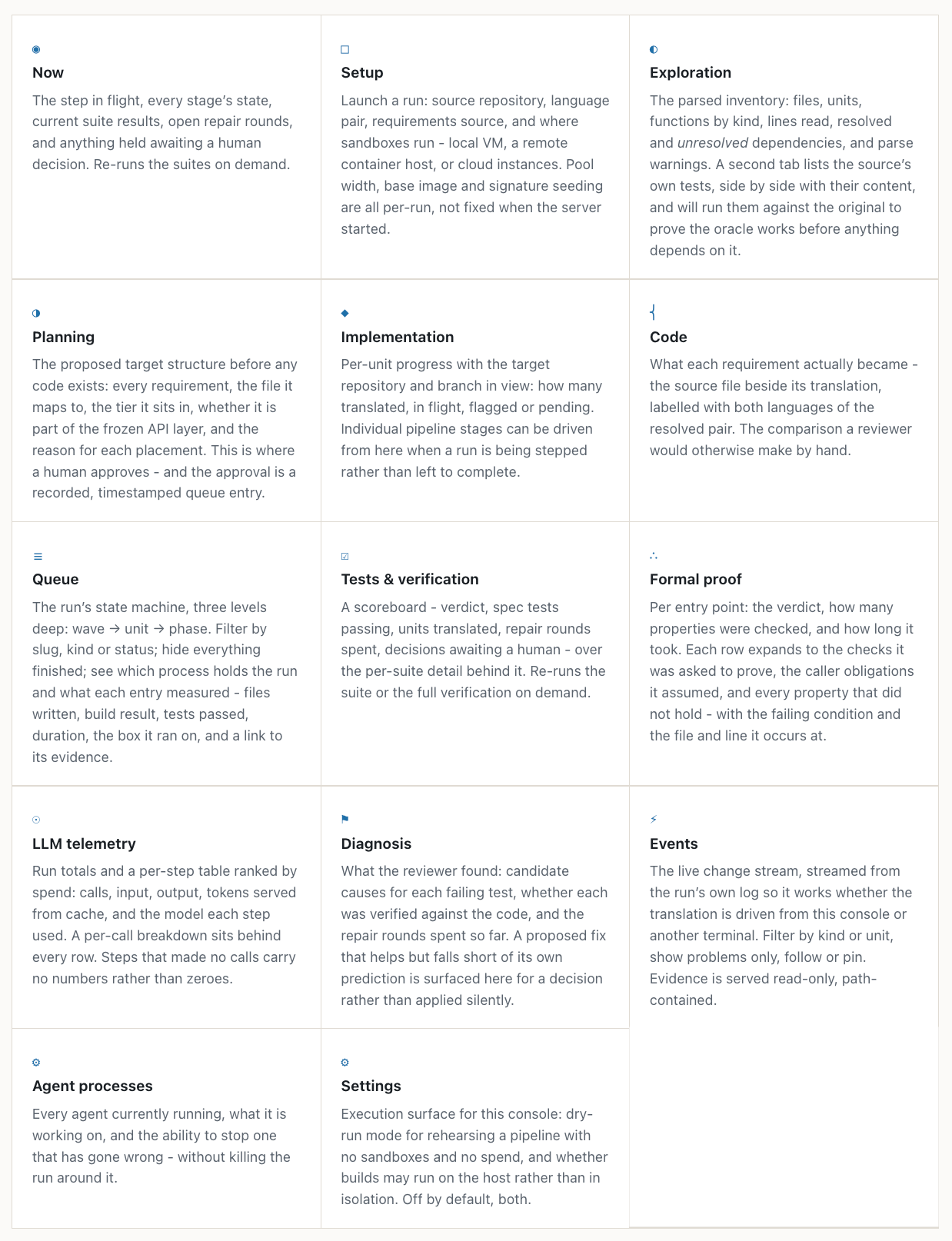
A run is launched, watched, paused and inspected from one console. Each surface answers a different question, and every number shown traces to a file on disk.
Run control
A run takes hours, and can be interrupted. Pause is honoured between steps and at wave boundaries - never mid-unit, because a sandbox already translating has been paid for. Resume picks up from the last recorded verdict rather than the top: a unit whose box already answered is not re-run, and its output is reused.
A hard kill leaves entries that claim to be running when nothing is. Helix detects that by process identity rather than a timer - a translation can legitimately go forty minutes without touching the queue - reclaims those entries, and says it did so rather than quietly repairing them. A new attempt mints a fresh queue and marks the old one superseded rather than overwriting it, because a queue is the record of what a run did.
Diagnosis and repair
When a translated test disagrees with the implementation, the question is which one is wrong. A recorded answer key acts as referee where one exists. Proposed fixes are held to a rule that makes them safe to accept:
-
the passing set is captured before any edit, because afterwards "already broken" and "this patch broke it" are indistinguishable;
-
a fix that repairs its target and breaks anything else is reverted, whatever it fixed;
-
a fix that helps but falls short of its own prediction is held for a decision rather than applied silently;
-
a repair may never edit the tests it is judged by.
Scope of the proofs
For a proved entry point, the claim is mathematical: no input satisfying the source contract can violate the checked properties. Not sampled, not fuzzed - every reachable state within the analysis bound is examined. This is a different kind of statement from a test result, which reports only the inputs that were tried.
Helix is equally precise about the boundary. Proofs are bounded, so an entry point that did not conclude is reported as such, never as passing. Where the caller's obligations were assumed, they are listed alongside the result, so a proof is always read together with its premises. Constructs that would make a verdict unsound are refused rather than answered.
Assumptions are listed next to each result, so a reviewer can examine the premises rather than only the conclusion.
Auditability
The record is the artefact
Everything is checked into the target repository alongside the code it describes: the requirement graph, the approved structure, per-unit state, and per-attempt evidence including the exact prompt, the sandbox output, and the model usage. The run queue itself is versioned in its own history, so a hand edit is detectable rather than invisible.
| Question | Where it is recorded |
|---|---|
| Why is this function in this file? | The approved structure, gated before any code was written |
| What was this unit asked to do? | Per-attempt prompt, stored beside its output |
| Did a human approve the plan? | An explicit queue entry with a timestamp |
| What did this step cost? | Provider-reported usage on the entry, plus a per-call table |
| What is proved, and under what assumptions? | Per entry point, with the assumed preconditions listed |
| What changed after a merge conflict? | The resolution diff, stored per unit per wave |
Results summary
| Capability | Measured |
|---|---|
| Automated port of safety-critical Ada | 12/12 units · 2,408 lines · single pass |
| Idiomatic target structure, not file-for-file | 24 files, concept-grouped |
| Constrained types preserved, not erased | 20/20 range types, bounds intact |
| Dependency-aware parallel execution | 3 waves · 10 concurrent sandboxes |
| Clean integration | 12 merges · 0 conflicts · 3/3 gates |
| Behavioural equivalence testing | 4 suites · 253 assertion sites |
| Exhaustive formal verification | 27 entry points proved · 1,026 properties |
| Defects found beyond test coverage | 56 counterexamples, file and line |
| Full cost attribution | 226 calls, per step and attempt |
| End-to-end auditability | 80 recorded operations |
Every step, sandbox, model call and property - proved or left open - is recorded in the target repository alongside the code, so the run can be reviewed against its own evidence.